
Authors: Alena Valtonen, Mira Holopainen / LUT
–
Smart technologies are rapidly transforming the way we work. Artificial intelligence, digital twins, and robotics bring efficiency and a competitive edge, but one aspect is often overlooked: how does this change affect employees’ daily lives and well-being? This question becomes even more important in the Industry 5.0 era, where success is also built on a human-centered approach and sustainable work.

As technology advances but the nature of work becomes more complex, the impact of technological change on people must also be measured.
The "People at the Heart of Digital Transformation" (HumanDT) project, carried out by LUT University and funded by the European Regional Development Fund and the Regional Council of Päijät-Häme, is studying these impacts in collaboration with over 20 companies in Päijät-Häme. Interviews with Finnish industrial companies show that although there is significant investment in technology, only a few organizations systematically monitor how it is changing the way work is done.
A Human-Centered Assessment of Technological Change
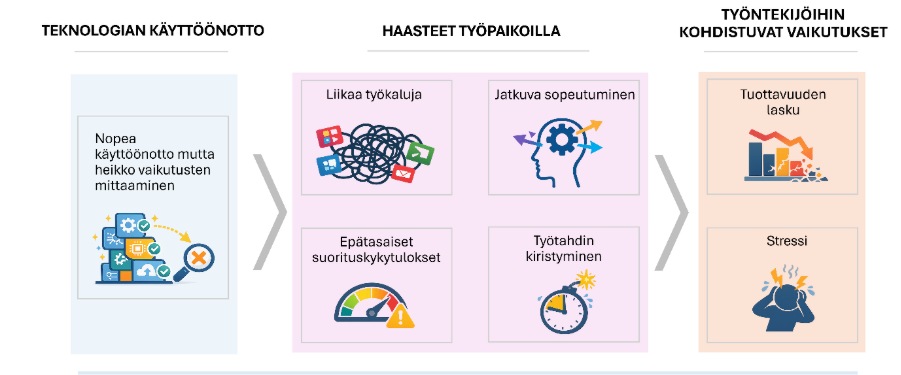
Companies, especially small and medium-sized enterprises (SMEs), often assess the impact of technology indirectly through managers’ observations, project metrics, or general employee surveys. As a result, many phenomena remain unseen. Four challenges emerged repeatedly in the study:
- The number of technological tools increases, dispersing information and making it harder to find.
- Constant updates and new systems require learning on the fly.
- Performance improvements don’t always happen immediately - work may temporarily slow down.
- The pace of work intensifies as the use of technology raises expectations and thus increases the workload.
In other words, the technical implementation of a technology may succeed, but in many cases work still becomes more demanding.
These findings underscore that digital transformation is not merely a technological challenge for companies, but also an organizational change whose many effects emerge gradually in day-to-day work. We therefore propose that, in order to gain a comprehensive picture of the consequences of technological changes, companies must shift from monitoring financial, operational, and project-based metrics toward the continuous assessment of work-related changes and the employee experience.
This means integrating new types of metrics into existing management systems, including, for example, measures related to coordination between teams, changes in workload and work pace, the learning requirements of new systems, and the usefulness of technology adoption. By understanding how technologies affect employees, companies can design practices and tools that help them leverage smart technologies more effectively while also maintaining sustainable and meaningful work.
Experiences from collaboration with companies
One concrete collaborative project was carried out with Nexpert Oy. The collaboration involved observing how participants from different organizations adopted artificial intelligence in workshops led by the company. During the process, valuable and practical information was gained on what kinds of experiences, insights, and learning needs new technologies evoke in different work communities.
The collaboration with Nexpert also fostered an understanding that supports the development of new evaluation methods and training approaches. This will enable us to better grasp the employee-centric impacts of technological change in the future. These experiences reinforced the project’s key finding: the impacts of technology cannot be understood solely from a technical perspective; rather, they must be complemented by in-depth knowledge of everyday work, learning processes, and changes in workloads.

alena.valtonen@lut.fi
Performance Management Research Group / LUT

mira.holopainen@lut.fi
Performance Management Research Group / LUT



Filed under