In the design of transport routes and demanding infrastructure projects, quality management has become a key role. As projects grow and the use of data-based planning becomes more common, reviewing and managing the design documentation using manual methods easily becomes a bottleneck. As a result of the three-year joint development led by Nexpert, a model for the self-disposal of design was created., based on which Nexpert has developed a new generation app – Bridget App. The application is solely a solution developed and created by Nexpert.
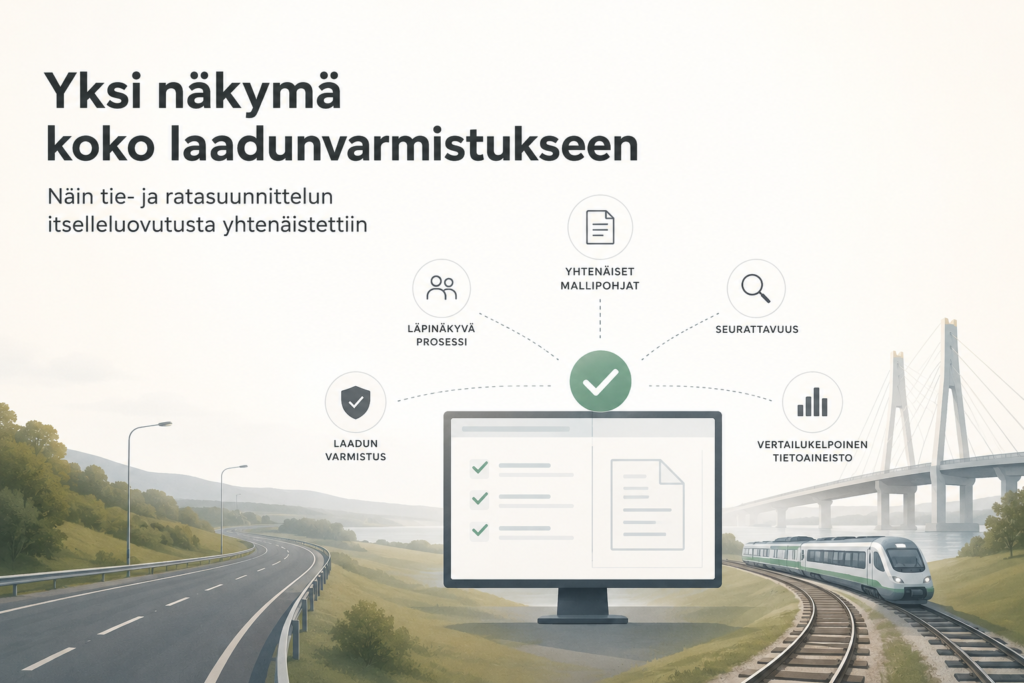
Bridget App is the concrete result of the next phase in the development of design self-dissemination and quality assurance. The application brings together design consultants, inspectors, and clients on a unified, digital platform that enables the transparent, flexible, and error-free review and approval of materials.
1. Assignment of responsibility for design to the client and Quality requirements of the Channel Authority
Why is the surrender of design to itself more critical now than ever? The technical and operational guidelines provided by the Road Administration – such as Quality assurance of the road project and Planning information management -guidelines – require that the project quality materials and documentation be systematically created at an early stage of planning and implementation.
The core idea of the Quality Process of the Finnish Transport Agency is that the delivery material must not be assembled until the very end of the project. If the collection of the material is left to the final phase of the project, the risk of erroneous traceability of the data and incomplete inspection markings increases. Quality assurance must be a continuous process:
- Continuous documentation: Every design solution, material version, and quality assurance phase is documented immediately upon their creation.
- Traceability: The data must be accurately linked to the correct structural elements, data models, and drawing debris.
- Processual self-surrender: The designer and the design team must verify the compliance of the material before it is submitted for internal or external review and approval by the client.
Bridget App is directly responsible for this quality assurance framework defined by the Finnish Transport Agency. The application digitizes and automates the quality control workflow so that no material is sent forward without a proper audit history and approval.
2. Bridget App's key features and role-based work schedule
The Bridget App’s interface is designed to be clear and role-based. From the application’s front page, the user can choose a workspace that suits their role. The system supports four key roles: Designer, Internal auditor, External auditor yes Customer.
- Designer's workspace – Inspection packages and milestones
The designer's view initially opens up to the projects that are currently under development.
- By clicking on the project card, the designer can access the project's data list.
- Audit packages and milestones: The designer can group materials and send complete inspection packages to an internal auditor, or plans tied to specific milestones of the project. Individual materials can also be sent. .
2. Roles of the internal and external auditor – Flexible approval chain
The internal auditor is responsible for the quality assurance of the design office itself. The role of the external auditor, on the other hand, is chosen on a project-by-project basis in those projects where external auditing is included in the contract.
In the work space of the inspectors, Bridget App brings two significant functional improvements:
- Approval for a repair request: The inspector can accept the material conditionally with a notation ”Accepted repair request”. This means that detected minor errors or replenishment needs must be rectified before final approval, but the material can still continue its journey through the inspection and approval chain without unnecessary interruptions.
- Individual rejections vs. packages: In traditional systems, a single image error can deadlock the entire 50 drawing delivery package. In Bridget App, approvals and rejects can be handled in a completely flexible way:
– At the level of individual material: Only the one incorrect file can be rejected from the package, while the remaining 49 are accepted for onward processing.
At the package level: A certain component (e.g., drainage instructions) is accepted and another (e.g., geotechnical engineering) is returned for completion.
– At the level of the entire planning file: The entire package is processed at once.
3. The client's work space – Overview and decision-making
The customer's work space emphasizes the control of the overall project. In addition to final approval of the materials, the customer is also offered real-time situational overview:
- The client can see at a glance which materials have been reviewed, which are awaiting repairs, and which are ready for decision-making.
- Thanks to the flexible approval logic, the customer can accept the pre-assembled parts and advance the project on schedule.
3. Future roadmap: Deep integrations into Finnish project banks
The current version of Bridget App presented today has been implemented using the agile ”vibe coding” concept, which enabled the rapid testing of the user interface and the functional workflow.
The focus of the continued development of the application and the future roadmap is on the hard coding and integration of the system into the background systems of the design consultants as well as the most common project databases and CDE (Common Data Environment) platforms in Finland.
Bridget App can be used to supplement the processes of design offices as a smart quality assurance layer that seamlessly integrates with the industry's leading project management systems, e.g.:
- Buildercom BEM: A project bank widely used in Finnish infrastructure construction and real estate projects, to which Bridget brings an automatic quality assessment and inspection layer.
- SokoPro: The well-known document management and project banking system in the construction industry, where the status information of inspection packages and the approval history are synchronized automatically.
- Dalux (Dalux Box / CDE): A platform used especially in data model-based (BIM) design and construction, where Bridget’s component-level approvals streamline the management of model versions.
- Infrakit: Cloud service tailored to the infrastructure sector and a data model management platform where the delivery files for channel projects and terrain models are reviewed in real time.
- Gravicon Modelspace: A specialized system for design guidance and status management, to which Bridget provides a direct interface for tracking design tasks and milestones.
- M-Files: A knowledge management system that many engineering offices use in their internal document circulation.
Thanks to the integrations, the designer no longer has to enter data manually in multiple different places. Bridget takes care of the review process and transfers the approved materials directly to the project’s official project bank.
4. Coming in the autumn: Visual comparison of DWG and BIM images (ODA library)
One of the most anticipated features of Bridget App in the near future involves visual verification of design changes. During the autumn, a new technical library will be integrated into the application, which will enable the automatic comparison of DWG-CAD drawings and BIM data models.
The feature is based on SDK technologies compliant with the industry standard developed by the Open Design Alliance (ODA) (Drawings SDK, Visualize SDK yes inWEB SDK):
- 2D DWG drawing comparison: The user can set two different viewing versions of the DWG image to overlap in the browser, in which case the system highlights the colorsized geometries and texts.
- 3D BIM and IFC model comparison: As far as data models are concerned, the ODA library enables the visualization of structural and attribute changes in IFC and Revit models directly in a performance-optimized online viewer.
- Perfectly delivered deliveries: When the designer and inspector see the changes graphically without separate heavy CAD software, infrastructure clashes and version errors are eliminated before the customer is handed over.
5. Summary
Bridget App shows how quality assurance in design and the self-disclosure required by the Transport Agency transform from a heavy bureaucracy into a powerful tool for streamlining design projects. The self-disclosure model based on the co-creation driven by Nexpert and the Bridget app developed by Nexpert bring quality assurance into the everyday design workflow through a clear role assignment, inspection packages, and flexible approval logic.
The integration work initiated by the agile VIBEK-coded concept with Finnish project banks (Buildercom, SokoPro, Dalux, Infrakit) and the ODA-based DWG/BIM comparison to be released in the autumn make Bridget a solution that will redefine the quality management of infrastructure design. You can take a look at the application through the link found in the comments.
Filed under